Mysterious Habenaria medusa: A Botanical Marvel Resembling Mythical Locks


Plant Information
Mysterious Habenaria medusa: A Botanical Marvel Resembling Mythical Locks

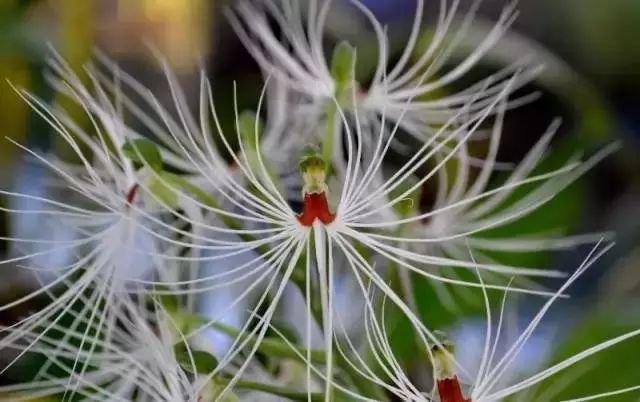
In the heart of the lush Southeast Asian rainforests, a plant of otherworldly beauty lies in wait, captivating all who encounter it. The Habenaria medusa, a member of the Orchidaceae family, has earned its name from the Greek mythological figure Medusa, whose hair was made of writhing snakes. This terrestrial orchid is a true wonder of nature, with its petals unfurling into sinuous, snake - like tendrils that seem to dance in the breeze.

The Habenaria medusa typically reaches a height of 35 - 50 centimeters. Its stem is upright and cylindrical, sprouting from a fleshy, oval - shaped tuber. Near the base of the stem, 2 - 3 tube - shaped sheaths provide support, while above them, 4 - 5 (or sometimes as many as 7) closely - grouped leaves grow. These leaves, along with 3 or more bract - like small leaves higher up, are lance - shaped with long, tapering tips. The flower cluster is densely packed, spanning 6 - 18 centimeters. The large, green - white blossoms are a sight to behold, with their unique, fringed lip petals that give the plant its distinct appearance. The blooming period, from July to August, transforms the forest floor into a fairytale scene.


Native to Indonesia and other parts of Southeast Asia, including the island of Borneo, the Habenaria medusa thrives in warm, humid environments. It prefers the dappled shade of the forest understory, where the soil is rich in organic matter and retains moisture well. This orchid has adapted to attract specific pollinators, most likely moths, with its sweet - scented nectar hidden in a spur at the back of each flower. As the moths visit the flowers in search of nectar, they inadvertently transfer pollen, ensuring the plant's reproduction.


Despite its allure, the Habenaria medusa faces numerous threats in the wild. Deforestation, driven by logging and agricultural expansion, is rapidly destroying its natural habitat. The demand for rare orchids in the horticultural trade also poses a significant risk, as illegal collection has led to a decline in its population. Conservation efforts are underway to protect this precious plant, including the establishment of protected areas and initiatives to promote sustainable cultivation. Botanists and conservationists are working together to study the plant's ecology and develop strategies to ensure its survival.


In the world of botany, the Habenaria medusa stands out as a symbol of nature's creativity and resilience. Its unique appearance and cultural significance make it a plant worth protecting. Whether admired for its beauty or studied for its ecological importance, the Habenaria medusa continues to fascinate and inspire, reminding us of the wonders that lie within our natural world.

Latest Stories
Astro Information2 minute readResembling a double-bladed lightsaber, this stunning Hubble Space Telescope image captures Herbig-Haro 24 (HH 24)—a half-light-year-wide jet erupting from a newborn star in the Orion B molecular cloud complex, ~1,300 light-years (400 parsecs) from Earth. HH 24 exemplifies the violent beauty of star birth, where invisible forces carve luminous pathways through interstellar space.
Feline News2 minute readThe Oriental Shorthair, a breed celebrated for its striking elegance and dynamic personality, traces its origins to mid-20th century breeding programs in the UK and the US2. Developed as a close relative of the Siamese, these cats emerged from intentional crossbreeding with British Shorthairs and Abyssinians to create a feline with the Siamese’s sleek physique but expanded coat color possibilities28. By the 1970s, the breed gained international recognition, captivating cat lovers worldwide with its unique charm.
Bird Information1 minute readLiving primarily in tropical oceans, frigatebirds boast wingspans exceeding 2 meters, with males sporting a distinctive red throat pouch that inflates like a scarlet balloon during courtship. These avian marvels are renowned for their ability to fly continuously for two months without touching water—even sleeping mid-air.
Feline News1 minute readNICOSIA, Cyprus – Roaming freely through the streets, ancient ruins, and coastal villages of Cyprus, a distinctive feline with amber or tabby coats has become an iconic symbol of the island. These are Cyprus cats, often hailed as "living fossils" and cherished as a unique part of the Mediterranean nation’s heritage.
Astro Information1 minute readSegue 2, a diminutive galaxy spanning just 220 light-years and hosting fewer than 1,000 stars, stands in stark contrast to giants like IC 1101—making it appear as cosmic "stardust." Scientists suspect this tiny entity is an early-universe "relic," gravitationally bound to the Milky Way, forever stunted in its growth.
Canine News2 minute readThe American Pit Bull Terrier originated in 19th-century England, initially bred by crossing bulldogs with terriers for blood sports like bull-baiting and dog fighting. In the mid-19th century, it arrived in the U.S. with immigrants and was gradually refined into a farm working dog and family companion. While not officially recognized by the American Kennel Club (AKC), it is registered as a distinct breed by the United Kennel Club (UKC) and the American Dog Breeders Association (ADBA
Feline News1 minute readThe Serengeti cat, a captivating breed celebrated for its striking resemblance to the African serval, has been gaining global attention among cat enthusiasts. Developed in the late 20th century through selective breeding—primarily crossing Bengal cats with Oriental Shorthairs—this breed was crafted to embody the grace of wild felines while maintaining a domesticated temperament.