The Enigmatic Rafflesia: Nature's Giant and Stinky Wonder


Plant Information
The Enigmatic Rafflesia: Nature's Giant and Stinky Wonder

In the heart of Southeast Asia's lush rainforests lies a botanical marvel that has intrigued and bewildered observers for centuries - the Rafflesia. This extraordinary plant is a genus within the Rafflesiaceae family, with around 42 species, each one a testament to nature's eccentricity.

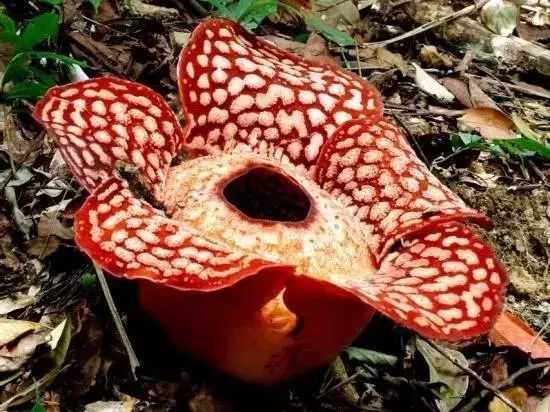
The Rafflesia is perhaps best known for its colossal flowers. The star of the show, Rafflesia arnoldii, flaunts the title of having the world's largest individual flower. These behemoths can reach up to a staggering 1 meter in diameter and tip the scales at around 11 kilograms. Their appearance is as striking as it is peculiar. Five thick, leathery petals, usually in hues of reddish - brown and adorned with white, wart - like spots, surround a central, bowl - shaped structure. The flower's interior often features a diaphragm - like formation, adding to its otherworldly look.


What truly sets the Rafflesia apart, however, is its pungent odor. Nicknamed the "corpse flower" or "meat flower," it emits a stench that closely mimics the smell of rotting flesh. This putrid aroma is no accident; it's a brilliant evolutionary adaptation. The Rafflesia's main pollinators are carrion - feeding flies. By mimicking the scent of decay, the flower lures these insects, which unwittingly transfer pollen as they explore the flower in search of a meal. Some species even go a step further, generating heat to enhance the illusion of decomposition, making the deception all the more convincing for their pollinator visitors.


Adding to its mystery, the Rafflesia has a highly unusual lifestyle. It is an endoparasite, meaning it has no roots, stems, or leaves in the traditional sense. Instead, it spends most of its life hidden within the tissues of its host, the Tetrastigma vine, which belongs to the grape family (Vitaceae). The Rafflesia exists as a network of thread - like filaments, leaching nutrients and water from the vine. Only when it's time to bloom does the plant make its presence known, emerging from the host as a bud that gradually develops into the massive flower.


The discovery of the Rafflesia was a momentous event in the world of botany. In 1818, an exploration party in Sumatra, led by Sir Stamford Raffles and including Dr. Joseph Arnold, stumbled upon this extraordinary plant. Dr. Arnold was the first to document it, and later, in 1820, Robert Brown named the genus Rafflesia in honor of Raffles, and the species Rafflesia arnoldii after Arnold.


Sadly, the Rafflesia is under threat. Deforestation, driven by logging and land - use changes, is destroying its rainforest habitat. Additionally, the illegal collection of the flowers for their supposed medicinal properties further endangers these rare plants. As of now, many Rafflesia species are considered rare, and some, like Rafflesia philippensis, are critically endangered according to the IUCN Red List. Conservation efforts are crucial to safeguard these botanical wonders, ensuring that future generations can also marvel at the Rafflesia's unique beauty and strange allure.
Latest Stories
Astro Information2 minute readResembling a double-bladed lightsaber, this stunning Hubble Space Telescope image captures Herbig-Haro 24 (HH 24)—a half-light-year-wide jet erupting from a newborn star in the Orion B molecular cloud complex, ~1,300 light-years (400 parsecs) from Earth. HH 24 exemplifies the violent beauty of star birth, where invisible forces carve luminous pathways through interstellar space.
Feline News2 minute readThe Oriental Shorthair, a breed celebrated for its striking elegance and dynamic personality, traces its origins to mid-20th century breeding programs in the UK and the US2. Developed as a close relative of the Siamese, these cats emerged from intentional crossbreeding with British Shorthairs and Abyssinians to create a feline with the Siamese’s sleek physique but expanded coat color possibilities28. By the 1970s, the breed gained international recognition, captivating cat lovers worldwide with its unique charm.
Bird Information1 minute readLiving primarily in tropical oceans, frigatebirds boast wingspans exceeding 2 meters, with males sporting a distinctive red throat pouch that inflates like a scarlet balloon during courtship. These avian marvels are renowned for their ability to fly continuously for two months without touching water—even sleeping mid-air.
Feline News1 minute readNICOSIA, Cyprus – Roaming freely through the streets, ancient ruins, and coastal villages of Cyprus, a distinctive feline with amber or tabby coats has become an iconic symbol of the island. These are Cyprus cats, often hailed as "living fossils" and cherished as a unique part of the Mediterranean nation’s heritage.
Astro Information1 minute readSegue 2, a diminutive galaxy spanning just 220 light-years and hosting fewer than 1,000 stars, stands in stark contrast to giants like IC 1101—making it appear as cosmic "stardust." Scientists suspect this tiny entity is an early-universe "relic," gravitationally bound to the Milky Way, forever stunted in its growth.
Canine News2 minute readThe American Pit Bull Terrier originated in 19th-century England, initially bred by crossing bulldogs with terriers for blood sports like bull-baiting and dog fighting. In the mid-19th century, it arrived in the U.S. with immigrants and was gradually refined into a farm working dog and family companion. While not officially recognized by the American Kennel Club (AKC), it is registered as a distinct breed by the United Kennel Club (UKC) and the American Dog Breeders Association (ADBA
Feline News1 minute readThe Serengeti cat, a captivating breed celebrated for its striking resemblance to the African serval, has been gaining global attention among cat enthusiasts. Developed in the late 20th century through selective breeding—primarily crossing Bengal cats with Oriental Shorthairs—this breed was crafted to embody the grace of wild felines while maintaining a domesticated temperament.