Uranus: The Celestial Ice Giant and Its Mythological Legacy


Astro Information
Uranus: The Celestial Ice Giant and Its Mythological Legacy

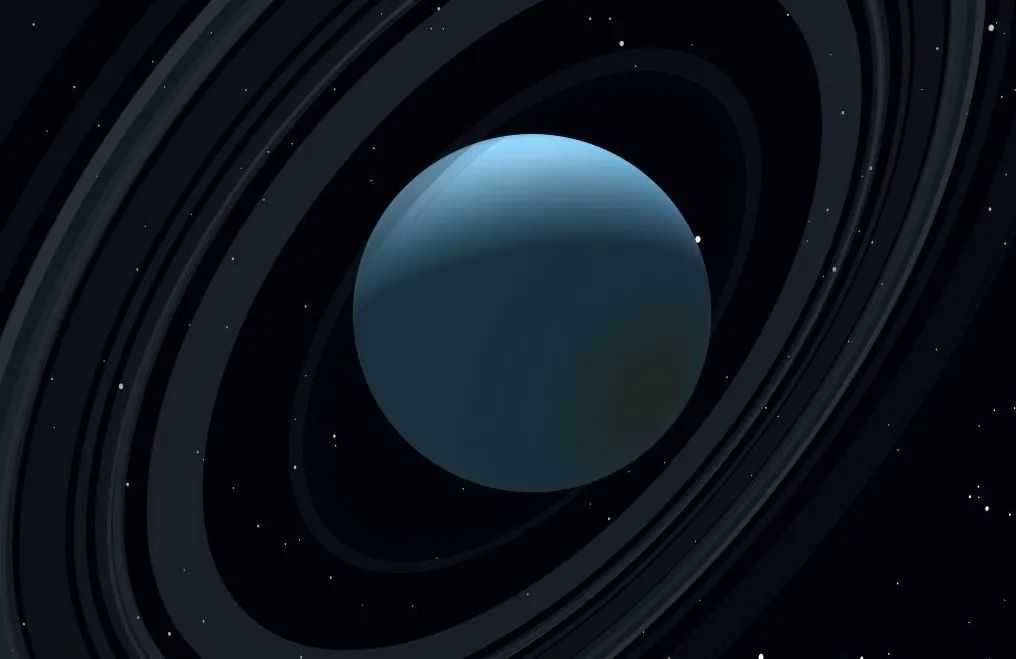
Uranus, named after the Greek god of the sky, "Ouranos," stands as one of the solar system’s most intriguing ice giants. With a radius of approximately 25,362 kilometers, it is the seventh planet from the Sun, distinguished by its pale blue hue and unique rotational axis. Unlike other planets, Uranus orbits on its side, a characteristic thought to result from a massive collision in its early history, giving it a distinct orientation in the solar system.


The planet’s atmosphere is primarily composed of hydrogen (83%) and helium (15%), with the remaining 2% consisting of "ices"—complex mixtures of water, ammonia, and methane. These icy compounds give Uranus its serene, pastel blue color: methane in the upper atmosphere absorbs red light, reflecting blue wavelengths back into space. Below the atmosphere lies a thick mantle of superheated, high-pressure icy fluids, which transitions into a small rocky core at the planet’s center. This structure classifies Uranus as an "ice giant," a category distinct from the gas giants Jupiter and Saturn.


Uranus’s unique tilt creates extreme seasonal variations, with each pole experiencing 42 years of continuous sunlight followed by 42 years of darkness. The planet has a faint ring system, discovered in 1977, consisting of narrow, dark rings made of dust and small rocks, and 27 known moons, most of which are named after characters from Shakespearean plays and Alexander Pope’s poetry. The largest moons, such as Titania and Oberon, are icy bodies with rugged terrains, including canyons and impact craters. While Uranus has been visited by only one spacecraft, Voyager 2 in 1986, ongoing observations by telescopes like the Hubble Space Telescope continue to reveal details about its atmospheric dynamics and magnetic field, which is offset from its rotational axis—a feature that adds to the planet’s enigmatic nature. As a distant sentinel of the outer solar system, Uranus remains a testament to the solar system’s diversity and the mysteries that still await discovery.
Latest Stories
Astro Information2 minute readResembling a double-bladed lightsaber, this stunning Hubble Space Telescope image captures Herbig-Haro 24 (HH 24)—a half-light-year-wide jet erupting from a newborn star in the Orion B molecular cloud complex, ~1,300 light-years (400 parsecs) from Earth. HH 24 exemplifies the violent beauty of star birth, where invisible forces carve luminous pathways through interstellar space.
Feline News2 minute readThe Oriental Shorthair, a breed celebrated for its striking elegance and dynamic personality, traces its origins to mid-20th century breeding programs in the UK and the US2. Developed as a close relative of the Siamese, these cats emerged from intentional crossbreeding with British Shorthairs and Abyssinians to create a feline with the Siamese’s sleek physique but expanded coat color possibilities28. By the 1970s, the breed gained international recognition, captivating cat lovers worldwide with its unique charm.
Bird Information1 minute readLiving primarily in tropical oceans, frigatebirds boast wingspans exceeding 2 meters, with males sporting a distinctive red throat pouch that inflates like a scarlet balloon during courtship. These avian marvels are renowned for their ability to fly continuously for two months without touching water—even sleeping mid-air.
Feline News1 minute readNICOSIA, Cyprus – Roaming freely through the streets, ancient ruins, and coastal villages of Cyprus, a distinctive feline with amber or tabby coats has become an iconic symbol of the island. These are Cyprus cats, often hailed as "living fossils" and cherished as a unique part of the Mediterranean nation’s heritage.
Astro Information1 minute readSegue 2, a diminutive galaxy spanning just 220 light-years and hosting fewer than 1,000 stars, stands in stark contrast to giants like IC 1101—making it appear as cosmic "stardust." Scientists suspect this tiny entity is an early-universe "relic," gravitationally bound to the Milky Way, forever stunted in its growth.
Canine News2 minute readThe American Pit Bull Terrier originated in 19th-century England, initially bred by crossing bulldogs with terriers for blood sports like bull-baiting and dog fighting. In the mid-19th century, it arrived in the U.S. with immigrants and was gradually refined into a farm working dog and family companion. While not officially recognized by the American Kennel Club (AKC), it is registered as a distinct breed by the United Kennel Club (UKC) and the American Dog Breeders Association (ADBA
Feline News1 minute readThe Serengeti cat, a captivating breed celebrated for its striking resemblance to the African serval, has been gaining global attention among cat enthusiasts. Developed in the late 20th century through selective breeding—primarily crossing Bengal cats with Oriental Shorthairs—this breed was crafted to embody the grace of wild felines while maintaining a domesticated temperament.