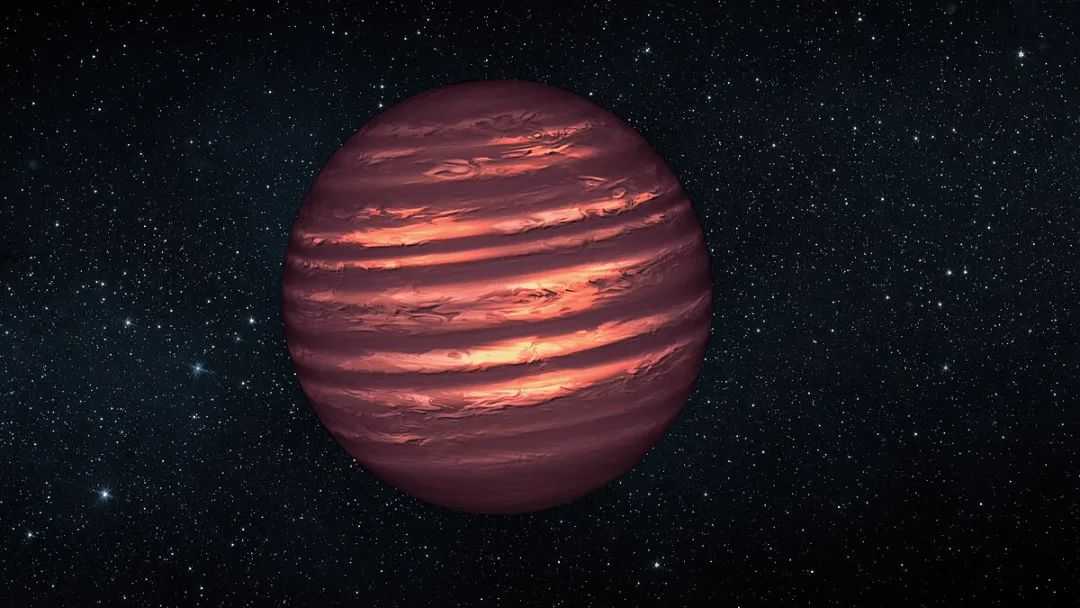
Brown dwarfs, often dismissed as "failed stars," hold profound significance for astronomy and cosmology, bridging the gap between planets and stellar bodies. Their study illuminates fundamental questions about cosmic evolution, interstellar physics, and even the nature of dark matter. Here’s how these enigmatic objects advance scientific understanding:
Brown dwarfs (13–80 Jupiter masses) occupy a unique mass niche, making them natural laboratories for studying the boundaries of star formation. Unlike stars, they cannot sustain hydrogen fusion, but their internal processes mimic stellar evolution in slow motion. By analyzing their atmospheres, temperatures, and magnetic fields, astronomers gain insights into:
- How mass determines whether a celestial body becomes a star, brown dwarf, or planet.
- The role of angular momentum and cloud fragmentation in early-stage stellar development.
- Why some brown dwarfs exhibit Jupiter-like storms or host exoplanet-like companions, blurring the line between "failed stars" and "super-planets."
Brown dwarfs form through the same gravitational collapse as stars but with truncated mass accretion. This makes them ideal for studying:
- Molecular cloud dynamics: How dense interstellar gas and dust collapse under gravity, influenced by turbulence and magnetic fields.
- Chemical enrichment: The composition of primitive stellar nurseries, revealed through brown dwarfs’ atmospheric spectra (e.g., water, methane, and metal abundances).
- Star-forming efficiency: Why only ~1% of interstellar material becomes stars, with the rest forming brown dwarfs, planets, or remaining as dust.
While brown dwarfs are not dark matter themselves (they emit radiation), early theories proposed they could be MACHOs (massive compact halo objects), a hypothetical dark matter component. Though modern observations show MACHOs make up only a tiny fraction of dark matter, brown dwarf research still aids:
- Cosmic mass budget calculations: Estimating how much of the universe’s mass resides in substellar objects versus stars, gas, and dark matter.
- Gravitational lensing studies: Rare brown dwarfs in the Milky Way’s halo can lens distant stars, helping map the galaxy’s invisible mass distribution.
Brown dwarfs share similarities with giant exoplanets, offering parallels for:
- Atmospheric studies: Comparing cloud patterns, storm systems, and chemical compositions between brown dwarfs (e.g., T-dwarfs) and gas giants like Jupiter.
- Formation mechanisms: Testing whether brown dwarfs form via stellar-like collapse or planetary-like accretion, informing theories about hot Jupiter origins.
- Habitable zone research: Some cool brown dwarfs (L-dwarfs) may host planets in their extended habitable zones, though their radiation environments remain harsh.
Brown dwarfs challenge theoretical predictions, forcing scientists to refine:
- Evolutionary tracks: Models like COND and DUSTY struggle to explain why some young brown dwarfs are brighter than expected, hinting at unaccounted physics (e.g., magnetic heating).
- Atmospheric chemistry: Why certain brown dwarfs show unexpected spectral features, such as alkali metal absorption or cloud opacity variations.
- Binary system dynamics: How brown dwarfs form in pairs or multiples, similar to stars, versus being ejected from protoplanetary disks.
From probing the Milky Way’s hidden mass to simulating exoplanet atmospheres, brown dwarfs serve as a bridge between stellar and planetary science. Their study not only enriches our catalog of cosmic objects but also provides critical tests for theories of galaxy formation, interstellar chemistry, and even the origins of life. As telescopes like JWST peer deeper into star-forming regions, these "failed stars" may yet reveal some of the universe’s most profound successes.