M63 (The Sunflower Galaxy): A Cosmic Sunburst in Canes Venatici


Astro Information
M63 (The Sunflower Galaxy): A Cosmic Sunburst in Canes Venatici

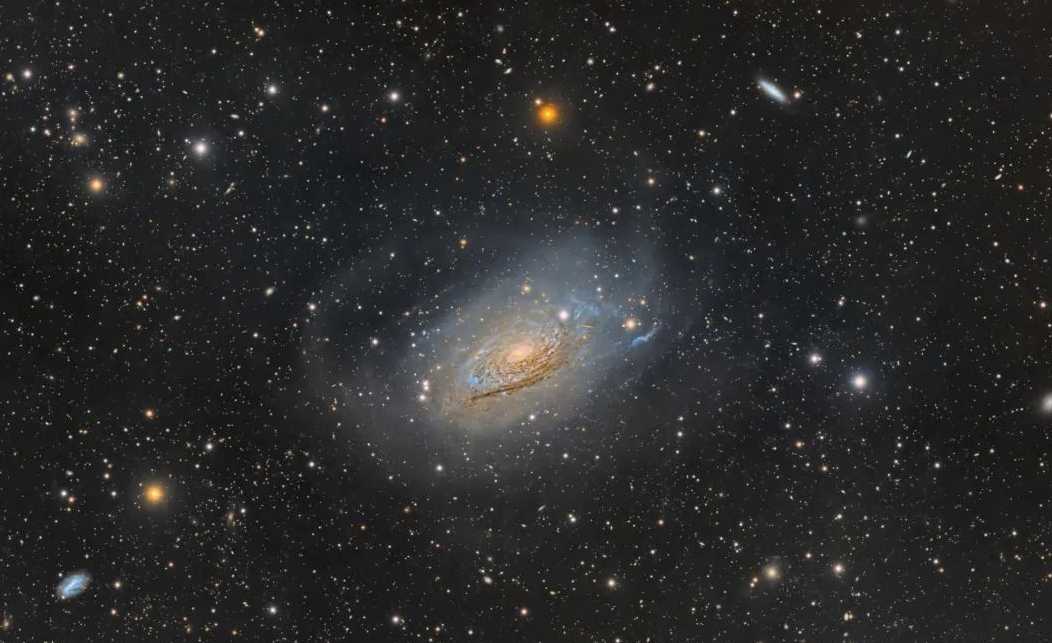
The bright spiral galaxy M63 (NGC 5055) shines in the northern sky, a mere 30 million light-years from Earth in the constellation Canes Venatici ("the Hunting Dogs"). Spanning ~100,000 light-years—comparable to the Milky Way—its luminous core and grand spiral arms earned it the nickname "Sunflower Galaxy," a nod to its petal-like structure in deep exposures.

Stellar Streams: Fossils of Devoured Satellite Galaxies

Deep imaging reveals faint stellar arcs stretching ~180,000 light-years through M63’s halo—remnants of satellite galaxies torn apart by tidal forces. These stellar streams are composed of stars stripped from smaller companion galaxies over billions of years, their orbits stretched into long, curved structures by M63’s gravity.


"Astronomers can read stellar streams like cosmic fossils," says Dr. Sofia Martinez-Delgado of the Max Planck Institute. "Each stream’s chemical composition and motion tells us about the galaxy’s accretion history."


The largest stream, discovered in 2019, traces a 270° arc around M63, suggesting the galaxy consumed a dwarf galaxy roughly 2 billion years ago.

Companions and Cosmic Evolution: A Galactic Ecosystem in Motion

M63 is not alone: its retinue includes several dwarf satellite galaxies, such as:


  • DDO 174: A faint irregular galaxy ~200,000 light-years away, gradually being pulled toward M63.
  • UGC 8335: A blue compact dwarf undergoing vigorous star formation, likely triggered by M63’s gravitational influence.


These companions will fuel M63’s growth in the coming billion years. As they approach, tidal forces will rip apart their stars, adding to the galaxy’s stellar halo and possibly triggering new waves of star formation in M63’s disk.

The Sunflower Galaxy: A Window into Galactic Archaeology

M63’s proximity makes it a prime target for studying galaxy evolution:


  • Star Formation History: Its spiral arms host active stellar nurseries, while the halo contains ancient stars from merged systems.
  • Dark Matter Probes: The rotation curve of M63’s outer disk (measured via hydrogen gas emissions) reveals the distribution of invisible dark matter.
  • Tidal Dynamics: The complexity of its stellar streams provides clues about the galaxy’s past mergers, a process central to how most large galaxies grow.


As telescopes like the James Webb Space Telescope peer deeper into M63’s halo, they’ll uncover more stellar streams and ancient stellar populations, rewriting the story of this cosmic sunflower’s rise to galactic prominence. For now, M63 stands as a living museum of galactic evolution—its petal-like arms blooming with the light of stars born over 10 billion years, interwoven with the ghostly remains of conquered cosmic neighbors.

Latest Stories
Astro Information2 minute readResembling a double-bladed lightsaber, this stunning Hubble Space Telescope image captures Herbig-Haro 24 (HH 24)—a half-light-year-wide jet erupting from a newborn star in the Orion B molecular cloud complex, ~1,300 light-years (400 parsecs) from Earth. HH 24 exemplifies the violent beauty of star birth, where invisible forces carve luminous pathways through interstellar space.
Feline News2 minute readThe Oriental Shorthair, a breed celebrated for its striking elegance and dynamic personality, traces its origins to mid-20th century breeding programs in the UK and the US2. Developed as a close relative of the Siamese, these cats emerged from intentional crossbreeding with British Shorthairs and Abyssinians to create a feline with the Siamese’s sleek physique but expanded coat color possibilities28. By the 1970s, the breed gained international recognition, captivating cat lovers worldwide with its unique charm.
Bird Information1 minute readLiving primarily in tropical oceans, frigatebirds boast wingspans exceeding 2 meters, with males sporting a distinctive red throat pouch that inflates like a scarlet balloon during courtship. These avian marvels are renowned for their ability to fly continuously for two months without touching water—even sleeping mid-air.
Feline News1 minute readNICOSIA, Cyprus – Roaming freely through the streets, ancient ruins, and coastal villages of Cyprus, a distinctive feline with amber or tabby coats has become an iconic symbol of the island. These are Cyprus cats, often hailed as "living fossils" and cherished as a unique part of the Mediterranean nation’s heritage.
Astro Information1 minute readSegue 2, a diminutive galaxy spanning just 220 light-years and hosting fewer than 1,000 stars, stands in stark contrast to giants like IC 1101—making it appear as cosmic "stardust." Scientists suspect this tiny entity is an early-universe "relic," gravitationally bound to the Milky Way, forever stunted in its growth.
Canine News2 minute readThe American Pit Bull Terrier originated in 19th-century England, initially bred by crossing bulldogs with terriers for blood sports like bull-baiting and dog fighting. In the mid-19th century, it arrived in the U.S. with immigrants and was gradually refined into a farm working dog and family companion. While not officially recognized by the American Kennel Club (AKC), it is registered as a distinct breed by the United Kennel Club (UKC) and the American Dog Breeders Association (ADBA
Feline News1 minute readThe Serengeti cat, a captivating breed celebrated for its striking resemblance to the African serval, has been gaining global attention among cat enthusiasts. Developed in the late 20th century through selective breeding—primarily crossing Bengal cats with Oriental Shorthairs—this breed was crafted to embody the grace of wild felines while maintaining a domesticated temperament.